



Forum Replies Created
-
AuthorPosts
-
RalfParticipant
Hello Siar,
Thank you very much for the important information that DeltaEC is now being further developed; I hadn’t checked for a long time because I’d given up hope.
That’s really great news!At 2040 rpm, a plastic piston with a diameter of 60 mm, a mass of 24 g and a stroke of approximately 20 mm is driven with a restoring force by a small diaphragm.
At 1940 rpm, a diaphragm with a diameter of 125 mm, thickness t = 1 mm, a magnetic mass of 11 g and a stroke of approximately 20 mm is used, without any restoring force.
At 2,600 rpm, the same diaphragm is used with a magnetic mass of 9 g and a slight restoring force provided by the coil.
I hope this helps; if you need any more data, just let me know and I’ll look them up for you.
After a few weeks focusing on other things, I’m now continuing my work on the thermoacoustic motor and will be trying out lots of new things this week and carrying out extensive test runs.
I’m currently in close contact with Jaime Gros, whom you may know from some DeltaEC publications; I hope to get a lot of help from him as well.
On our Discord server, a number of experts have already carried out intensive AI automation experiments with DeltaEC; it’s definitely worth you having a look there – there’s bound to be plenty of interesting information for you, although it’s been a few months now.I hope to hear more from you; your project sounds very interesting.
If you present your project on Discord, I’m sure lots of people will be interested – there’s far more going on there than here.Thank you very much for your interest, and see you soon
Ralf
RalfParticipantHi Siar,
Thank you very much for your very interesting findings.
Have you managed to get DeltaEC running on Linux?
I haven’t had any success with Wine or similar programs, so I’ve gone to the trouble of setting up a virtual machine with Windows 11, which is a bit impractical and slow.
Quite a few people have already tried to automate DeltaEC using AI; there’s a lot of material on this on our Discord server…
I’m very interested in your work, and when I have a bit of time I’ll send you all the necessary data.I really must get to grips with DeltaEC better – it’s a very complex subject…
Many thanks for your work; I’ll be in touch with the data soon…
Best regards,Ralf
2026-08-30 at 18:03 in reply to: Book: Producing Your Own Power by Stoner, Carol Hupping (Editor ) [1974[ #360RalfParticipantThank you very much for the link, the book looks really amazing and I will take a closer look at it for sure!
It has many very interesting topics that are really important!RalfParticipantThe engine’s power output is still very low, in the region of about 10 watts.
Most of this is lost to friction, but the forthcoming improvements – particularly the supercharging of the working gas – are expected to significantly increase the power output.
There isn’t much going on here in the forum yet; you’ll get more and quicker replies on our Discord server!RalfParticipantYour engine is truly fantastic; many people would be very interested in seeing a video or some photos uploaded here, on Discord or YouTube!
The technique using the membrane to curb the harmful Gideon streaming is very interesting; a few pictures would really help to understand it.
I believe many people also use a nozzle-shaped component (jet pump?) inside.
None of these measures are built into the current engine; I hope to minimise the harmful streaming through the design of the feedback loop combining inertia and compliance.
Rob and others are already working intensively with DeltaEC, and this can likely be taken into account in the calculations via integrated RPN modules.These are really great results; some further information and pictures of your motor would be fantastic!
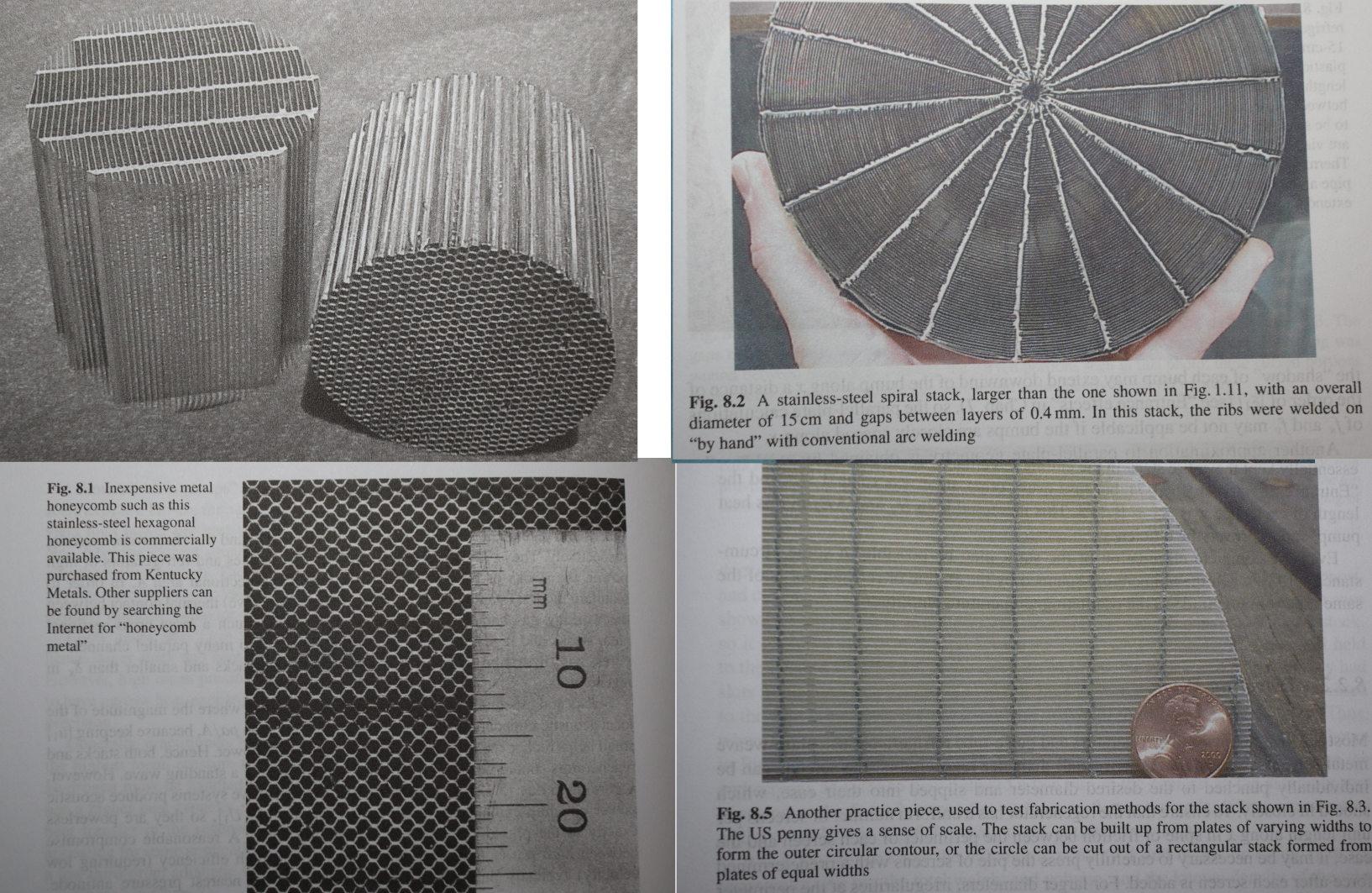
RalfParticipantYes, Swift prefers in his book also regenerators with channels!
I also have a picture of a ceramic casted regenerator but I could not find it!
 RalfParticipant
You have to add this feature by yourself as DeltaEC is designed for many different acoustic machines i think.
It is really worth to look at the papers of Carmen Iniesta, I can look the titles up or send the pdfs to you if you want!
RalfParticipantNo, as I think I made it too complex with several connections for pressurization, pressure measurement, pressure balancing and I also want to avoid the tread and use a proper flange solution for useful later adaptions!
I really have to try the clamping mechanism!RalfParticipantI calculated thermal penetration depth to 0.5 mm and assumed viscous pd to be similar.
I only estimated gas displacement amplitude which is really not optimal as this is a very important factor because of heat exchanger length!The length of the engine is typically a fraction (0.5 or 0.25 or 0.125? …) of lambda which is still quite long and I have to experiment further with the feedback loop length/volume.
I increased the length of the coolers because the first ones were only half as long as heater/regenerator just because the heat transfer of the coolers was better.
As far as I know, DeltaEC does not take into account the amplifying resonance effects of the feedback loop and therefore cannot be used to optimize the FBL without additional RPN code.
Carmen Iniesta has written a number of freely available papers on this subject, and I’m not sure whether the RPN modules are in in the DeltaEC code from the book! -
AuthorPosts