



HOME › Forums › Thermoacoustic Engines › General thermoacoustic theory
- This topic has 12 replies, 4 voices, and was last updated 3 days, 3 hours ago by siar.
-
AuthorPosts
-
2026-05-09 at 14:12 #293RalfParticipant
Thermoacoustic theorie is quite complex and complicated.
I designed the engines only with a few basic parameters:
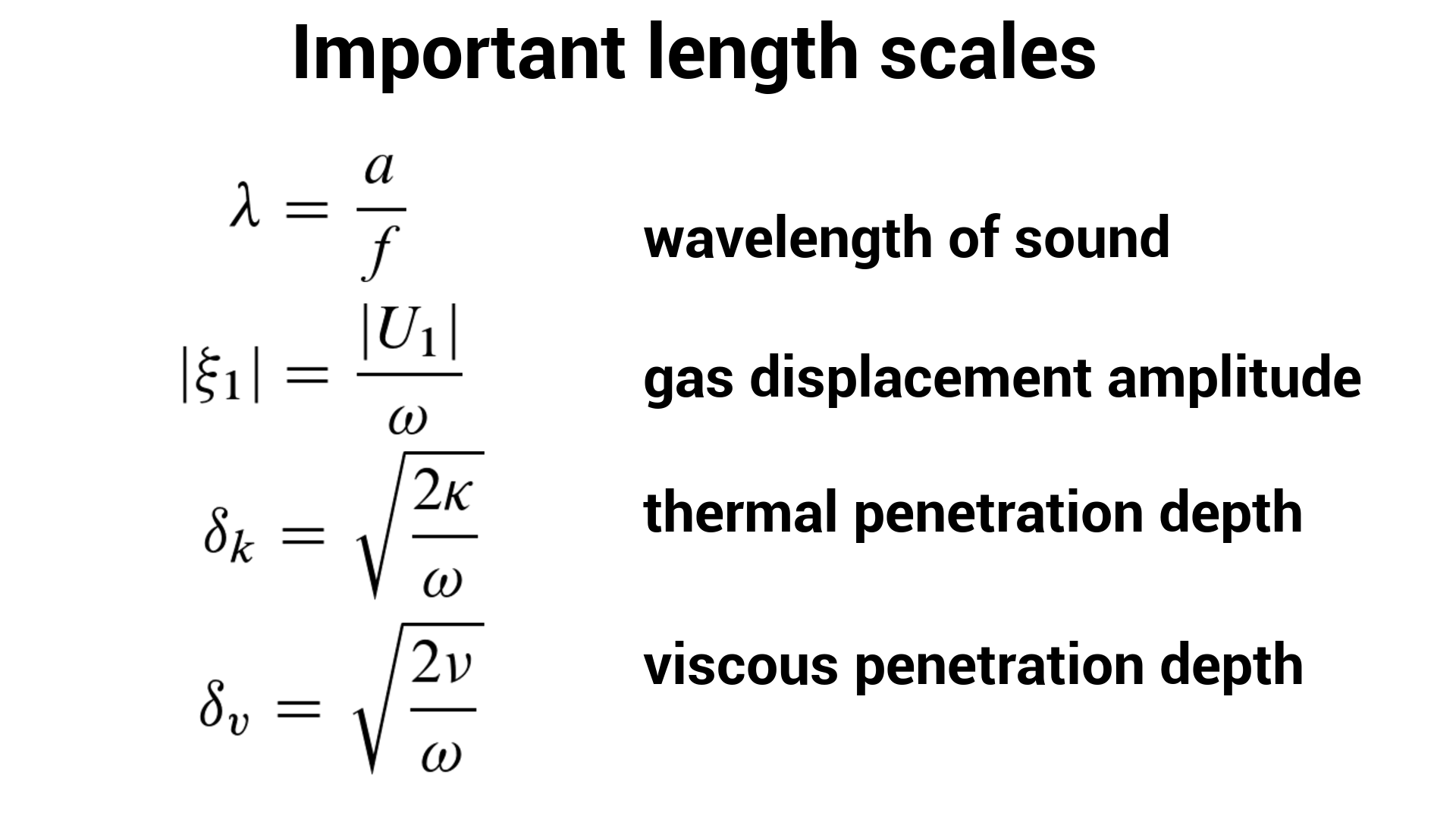
But the very important gas displacement amplitude which determines the maximum practical length of the heat exchangers is not exactly straightforward.
I really must get to grips with this as soon as possible, but at the moment I’m having far too much fun with practical experiments!Any help and suggestions on this topic are very welcome!
2026-05-09 at 16:42 #305jan_lParticipanttest message
2026-05-09 at 18:53 #308minthemercilessParticipantHow did you use these basic parameters and what values did you use for your calculations?
2026-05-09 at 18:55 #309minthemercilessParticipantAlso, what made you increase the length of your cold heat exchangers?
2026-05-09 at 19:57 #311RalfParticipantI calculated thermal penetration depth to 0.5 mm and assumed viscous pd to be similar.
I only estimated gas displacement amplitude which is really not optimal as this is a very important factor because of heat exchanger length!The length of the engine is typically a fraction (0.5 or 0.25 or 0.125? …) of lambda which is still quite long and I have to experiment further with the feedback loop length/volume.
I increased the length of the coolers because the first ones were only half as long as heater/regenerator just because the heat transfer of the coolers was better.
As far as I know, DeltaEC does not take into account the amplifying resonance effects of the feedback loop and therefore cannot be used to optimize the FBL without additional RPN code.
Carmen Iniesta has written a number of freely available papers on this subject, and I’m not sure whether the RPN modules are in in the DeltaEC code from the book!2026-05-09 at 21:21 #312minthemercilessParticipantThere is a calculation for feedback loop loss, but there doesn’t seem to be any RPN calculations that feed into others, I.e. accounting for resonance.
I’ll have to look into the missing resonating behaviour. Seems odd that an acoustics solver doesn’t do resonance!
2026-05-09 at 22:14 #319RalfParticipantYou have to add this feature by yourself as DeltaEC is designed for many different acoustic machines i think.
It is really worth to look at the papers of Carmen Iniesta, I can look the titles up or send the pdfs to you if you want!
2026-05-09 at 23:01 #320minthemercilessParticipantpdfs or paper titles would be excellent! If you have pdfs to share, you can send them via Discord.
2026-11-04 at 08:14 #366siarParticipantDeltaEC in batch mode on Linux, driven by an AI coding agent
Hi Ralf, hi everyone,
a workshop note rather than a result. I have been rebuilding your printed loop (compliance, hose, T-junction with membrane) in DeltaEC on Linux, and one thing turned out to be worth sharing: DeltaEC 7.0.2 has a console mode (DeltaEC -c model.out) that runs without any X server. It is a small text menu on stdin: r runs the model, w writes the result into the .out, y confirms the overwrite, e exits. With that, a shell script can run a model non-interactively, and an AI coding agent (I use Claude Code) can write dozens of variants of the .out, run them in a loop, and read guessz/targs back from the end of each file as the starting point for the next. Parameter sweeps over mesh, hose length or heater temperature then become a few minutes of unattended work instead of an evening of clicking. The agent also makes a reasonable DeltaEC assistant: it reads the manual, explains segment parameters and finds the reason when a run does not converge.
The limit is the usual one: the model is only as good as its inputs. For your loop I have the CAD parts, but two numbers would help more than anything else, if you happen to have them: the moving mass in grams for the runs where you measured 1943, 2039 and ~2600 rpm on the membrane, and the heater temperature at which the engine starts by itself. No hurry, and thanks for publishing the files and the test runs in such detail.
2026-11-06 at 14:22 #368RalfParticipantHi Siar,
Thank you very much for your very interesting findings.
Have you managed to get DeltaEC running on Linux?
I haven’t had any success with Wine or similar programs, so I’ve gone to the trouble of setting up a virtual machine with Windows 11, which is a bit impractical and slow.
Quite a few people have already tried to automate DeltaEC using AI; there’s a lot of material on this on our Discord server…
I’m very interested in your work, and when I have a bit of time I’ll send you all the necessary data.I really must get to grips with DeltaEC better – it’s a very complex subject…
Many thanks for your work; I’ll be in touch with the data soon…
Best regards,Ralf
2026-11-06 at 22:36 #369siarParticipantHi Ralf, DeltaEC runs natively on Linux for me — no Wine needed. There is DeltaEC 7.0.2 for Linux on the DeltaEC page (it’s labelled “DeltaEC 702 Linux”, built on Ubuntu 22.04): https://www.losalamosthermoacoustics.org/deltaec.html
I’d simply let an AI coding agent (Claude Code, Codex CLI, …) with shell access do the setup: download, unpack, install any missing libraries, do all the troubleshooting. The same agent can then drive DeltaEC via the console mode — that’s what I do. Best regards, Siar2026-11-07 at 15:58 #371RalfParticipantHello Siar,
Thank you very much for the important information that DeltaEC is now being further developed; I hadn’t checked for a long time because I’d given up hope.
That’s really great news!At 2040 rpm, a plastic piston with a diameter of 60 mm, a mass of 24 g and a stroke of approximately 20 mm is driven with a restoring force by a small diaphragm.
At 1940 rpm, a diaphragm with a diameter of 125 mm, thickness t = 1 mm, a magnetic mass of 11 g and a stroke of approximately 20 mm is used, without any restoring force.
At 2,600 rpm, the same diaphragm is used with a magnetic mass of 9 g and a slight restoring force provided by the coil.
I hope this helps; if you need any more data, just let me know and I’ll look them up for you.
After a few weeks focusing on other things, I’m now continuing my work on the thermoacoustic motor and will be trying out lots of new things this week and carrying out extensive test runs.
I’m currently in close contact with Jaime Gros, whom you may know from some DeltaEC publications; I hope to get a lot of help from him as well.
On our Discord server, a number of experts have already carried out intensive AI automation experiments with DeltaEC; it’s definitely worth you having a look there – there’s bound to be plenty of interesting information for you, although it’s been a few months now.I hope to hear more from you; your project sounds very interesting.
If you present your project on Discord, I’m sure lots of people will be interested – there’s far more going on there than here.Thank you very much for your interest, and see you soon
Ralf
2026-11-07 at 22:33 #372siarParticipantHi Ralf,
thank you for the details on the piston and membrane runs – that is exactly what I was missing. I’ll build it into the model when I find the time; at the moment I’m rather short of it, so no hurry on my side either.
Also thanks for posting the information on Discord. I had a look there but, to be honest, couldn’t quite find my way around – the channels and threads were a bit much for me, so your summary helps a lot.
Fingers crossed for the next steps with your engine, especially the pressurized runs. Looking forward to seeing how it goes.
Best regards,
Siar -
AuthorPosts
- You must be logged in to reply to this topic.